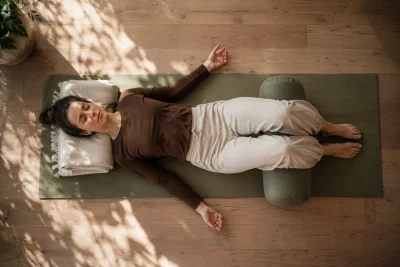
Picture the last minute of a class you loved. Savasana, lights low, a teacher's voice telling you that rest is not something you have to earn. It is a genuinely lovely idea, and for the sixty minutes you are on the mat, it is even true. It stops being true the second you walk out the door and the teacher starts driving to studio number two, where she will lead an intermediate flow for forty dollars, no benefits, and no guarantee that studio number three will still want her next month.
The wellness industry has built an entire identity around rescuing people from hustle culture. Yet a lot of the actual hustling is happening on the other side of the mat. Teaching yoga looks, from the outside, like a calling. Looked at closely, in most American studios, it is gig economy work wearing incense.
Most studios do not employ their teachers. They contract them, one class at a time, the same way a delivery app contracts a driver. The teacher shows up as an independent contractor, invoices the studio, and receives a 1099 at tax time instead of a W-2. That structure means no employer-paid health insurance, no paid sick time, no unemployment protection if the studio closes, and no guaranteed hours from one week to the next.
The justification studios usually give is flexibility, and for some teachers that really is the appeal. But flexibility and precarity tend to travel together. A widely cited Yoga Journal investigation into worker classification in the industry found that the majority of studios still hire teachers as contractors regardless of how many hours they actually work there, a pattern labor attorneys say frequently fails the legal test for genuine contractor status.
Part of what keeps per-class rates low is supply. Yoga Alliance, the industry's dominant credentialing body, has registered well over one hundred thousand teachers nationwide, according to figures the organization has reported through its own certification network, spread across more than seven thousand registered schools. New teachers keep entering the pipeline every year, often paying two thousand to five thousand dollars for a yoga teacher training program that studios and online academies market aggressively, sometimes with the promise of a six-figure teaching career waiting on the other side. For the schools running those trainings, certifying new teachers is itself a profit center. Whether every graduate finds paid work teaching yoga is, from a business standpoint, somebody else's problem. The result is a pool of newly certified instructors that keeps growing faster than the number of paid class slots, which hands studios the leverage to keep offering forty dollars a class and still fill the roster.
The federal government does not track yoga teachers as their own occupation. It folds them into the broader category of exercise trainers and group fitness instructors, which the Bureau of Labor Statistics pegs at a national median annual wage in the low fifty thousands. That figure includes gym employees on payroll, which is a very different arrangement from freelance studio teaching. Freelance per-class pay tells a rougher story. Reporting on real-world rates puts typical group class pay at thirty to seventy five dollars a session, with private clients closer to seventy five to one hundred fifty dollars. Teach four classes a week at the low end of that range, with no benefits stacked on top, and the total looks nothing like the salary figures that show up in a Google search for yoga teacher income. The studio economics only pencil out for the teacher once she is booking private clients, workshops, or teacher trainings of her own, none of which are guaranteed and all of which take years to build. It is not hard to see how that math, stretched across enough early mornings and late nights, turns into yoga teacher burnout long before it turns into a living wage.
Not every owner has accepted this as the cost of doing business. Down Under School of Yoga, with several locations in the Boston area, made the deliberate choice to convert its entire teaching staff to employee status, including instructors who teach just one class a week. Full-time teachers now receive health coverage, and the studio contributes to retirement accounts and paid sick time for its staff.
"If you teach one class for me you are an employee," founder Justine Wiltshire Cohen has said of the decision.
Wiltshire Cohen has been candid that the shift was expensive and took years of planning to afford. That honesty is worth sitting with. It suggests the contractor model most studios use is not an inevitable feature of the business. It is a choice, and a cheaper one, that most owners have simply not been asked to reconsider.
Yoga brands have gotten genuinely serious about scrutinizing where their materials come from, and rightly so. We have already looked at how closed-loop manufacturing is reshaping yoga apparel, chasing down every fiber's afterlife with the rigor of a supply chain audit. It is a genuinely good development. It is also a little strange that an industry capable of that level of scrutiny over a pair of leggings has spent so little of it on the person wearing the branded polo behind the front desk, let alone the one leading the class.
None of this requires guilt every time you walk into a studio. It does mean a few small habits carry more weight than most students realize. Buying class packages directly through a teacher's own private booking page, rather than only through a corporate app, keeps a larger share of that payment with the person who actually taught you. Tipping for a private session is normal and appreciated. Referring friends to a teacher by name, not just to the studio, helps her build the private client base that eventually makes the math work.
It is also worth watching where the technology is heading. Plenty of platforms now market AI-driven pose correction as a stand-in for a human teacher, which is convenient at six in the morning but also a quiet new source of downward pressure on an already thin income. A teacher who wants to build something more stable than a per-class rate usually needs a booking page and a presence of her own, the same basic infrastructure any small business owner needs. Getting that right is a more solvable problem than it sounds, and it often starts with the same site fundamentals any small business needs to get found online, the kind of groundwork independent teachers rarely have time to learn on their own.
The wellness industry has done an excellent job convincing the rest of us to slow down. It has done a considerably worse job extending that same permission to the people standing at the front of the room. The next time a teacher tells you to breathe, it might be worth wondering when she last got the chance to.