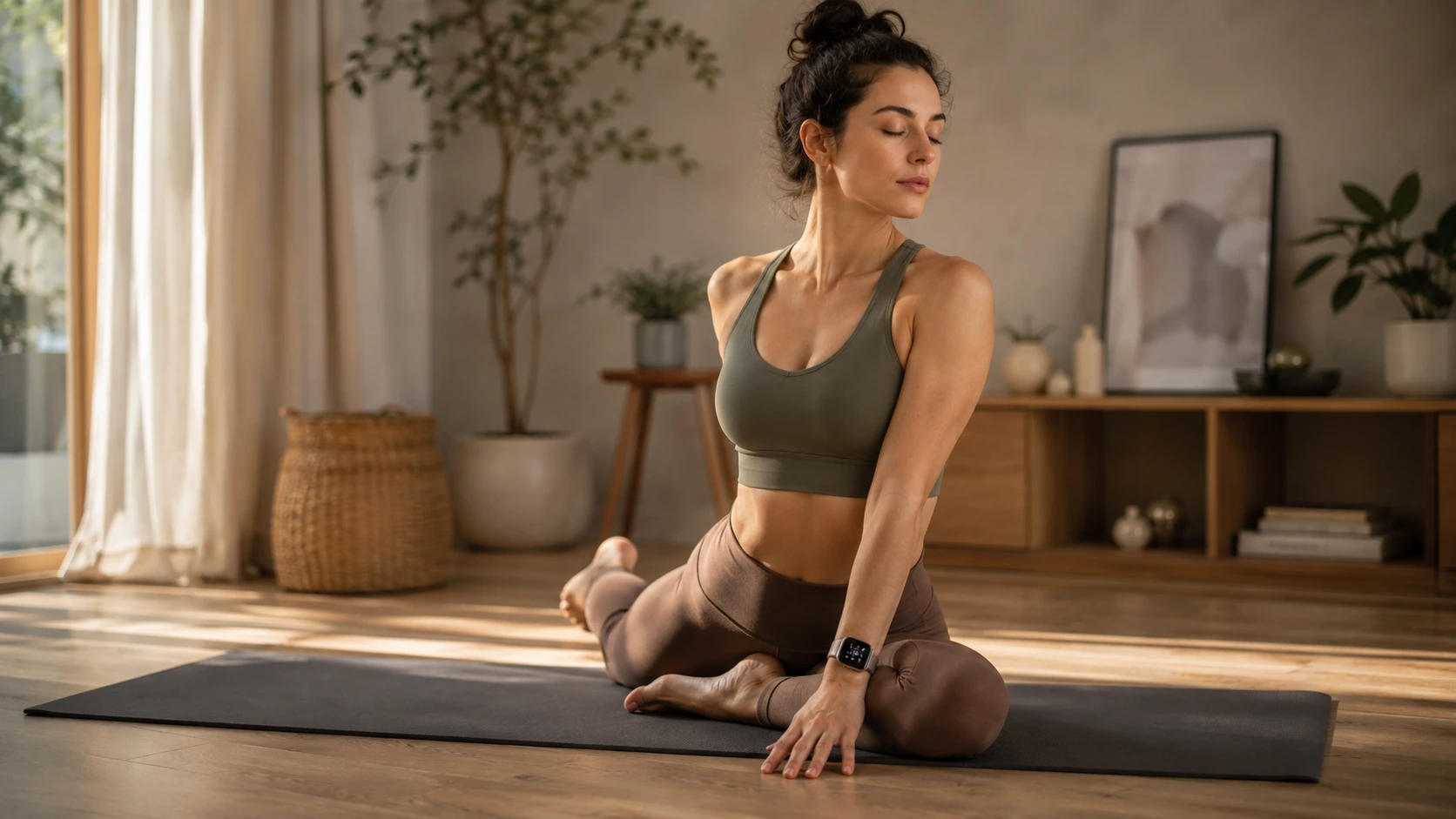
There is a quiet irony in checking your wrist for permission to relax. Yet that is increasingly how modern yoga begins. You wake, glance at a glowing readiness score, and decide whether today calls for a strong flow or a slow restorative session based on a number generated while you slept. Step onto the right mat and sensors map your weight distribution in real time, nudging your hips a half inch left. An app tells you your alignment is correct with a satisfying green check. The 5,000-year-old practice of turning inward now comes with a dashboard.
This is not a fringe advancement. For 2026, the American College of Sports Medicine named wearable technology the number one fitness trend in its annual worldwide survey of 2,000 fitness professionals, a position the category has reclaimed for the third consecutive year. Nearly half of U.S. adults now own a fitness tracker or smartwatch. The honest question, as the report's own authors put it, is no longer whether people will use these tools, but how to use them well. For a contemplative practice like yoga, that question has unusually high stakes, because the whole point is to feel something a screen cannot measure.
Start with the genuine upside, because there is real value here. The most useful application is recovery. Metrics like heart rate variability, the subtle beat-to-beat variation in your pulse, give a reasonable window into how taxed your nervous system is on a given morning. A low reading after a poor night or a stressful week is a legitimate signal to choose gentle, restorative movement over an ambitious sequence. Used this way, a tracker becomes a quiet argument for doing less, which is a message most of us need more often than the opposite. As ACSM's researchers note, real-time physiological data on sleep and recovery is reshaping how people decide when to push and when to rest.
The second real benefit is alignment feedback for people practicing alone. The standout example is the smart yoga mat, led by devices like YogiFi, which weaves pressure sensors directly into the mat surface and pairs them with computer vision to flag misalignments as you move. No camera framing required. A heat map shows exactly where your hands and feet are loaded, and the app prompts a correction until your form lands in range. For someone who has never had eyes on their practice and quietly worries they are doing it wrong, that kind of AI posture correction can be genuinely reassuring. If uncertainty about getting the poses right has kept you off the mat entirely, this is the case we made in our piece for people who think they cannot do yoga, and smart feedback removes one more excuse.
There is a continuity story here too. The yoga mat has always been the one piece of gear that defines a home practice, and watching it evolve from a passive surface into responsive equipment is a real shift in what we expect our tools to do. We traced an earlier chapter of that evolution in our look at closed-loop and sustainable yoga gear. The mat that once just held your poses now has opinions about them.
Before you reach for your wallet, a dose of perspective. Despite years of breathless predictions, the smart-mat category is far thinner than the marketing suggests. As Yoga Journal has pointed out, a wave of these products launched and quietly disappeared, and heading into 2026 the genuinely yoga-specific options remain few. The revolution that was promised has mostly not arrived, which is worth remembering when any single device is sold as essential.
The accuracy question matters just as much. The lead author of the ACSM report was refreshingly direct that while some wearable data is useful and accurate, other metrics may be "experimental or unreliable." Consumer-grade sensors estimate; they do not diagnose. A readiness score is an informed guess built from a handful of inputs, not a verdict on your body. Treating it as gospel can lead you to skip movement you would have benefited from, or to override how you actually feel because a graph disagreed. Readings can also swing for reasons that have nothing to do with your fitness, from a warm room to a glass of wine the night before to a sensor that simply lost contact with your skin. The number is a data point, not the truth.
Here is the deeper tension, and the reason this matters for yoga specifically more than for, say, running. The central skill yoga builds is interoception, the felt sense of what is happening inside your own body. Learning to notice the catch in your breath, the tension you carry in your jaw, the difference between a productive stretch and a warning, that is the practice. It is also precisely the capacity a screen can quietly erode. When the mat tells you the pose is correct, you stop asking your own body whether it feels right. When the watch declares you recovered, you stop checking in with how you actually slept.
A personalized yoga practice guided entirely by biometric data risks outsourcing the one muscle you came to strengthen. There is also the matter of attention. Yoga is, at its core, a tool for nervous system regulation, a way to shift the body out of constant alertness and into rest. It is hard to reach that state while glancing at a split screen for a green check, or while a corner of your mind stays tethered to the score you will see afterward. The very device meant to optimize the practice can hold you in the low-grade vigilance the practice is designed to release. That is not a small irony. It is the whole game.
None of this is an argument for throwing your watch in a drawer. It is an argument for sequence and hierarchy. Let the data inform the decision before you step on the mat, then let it go once you are there. Check your recovery and readiness signals over morning coffee, use them to choose the intensity of the day, and then practice unobserved. If you use a smart mat, treat its corrections like an occasional teacher's adjustment rather than a running commentary you chase pose to pose. The goal is to graduate from the feedback, not to depend on it.
It also helps to remember what the numbers are for. Recovery data is most valuable when it points you toward the unglamorous fundamentals, hydration, sleep, and genuine rest between harder efforts, the territory our colleagues at H2 Goals cover on readiness and HRV. A tracker that nudges you to drink more water and sleep an extra hour is doing more for your home yoga practice than one that gamifies every breath.
The technology arriving in wellness right now is impressive, and some of it is genuinely useful. But yoga has survived every century it has passed through precisely because its value was never in the equipment. The watch can tell you a great deal about your body. It still cannot tell you to close your eyes, breathe, and pay attention. That part, gratifyingly, is still yours.