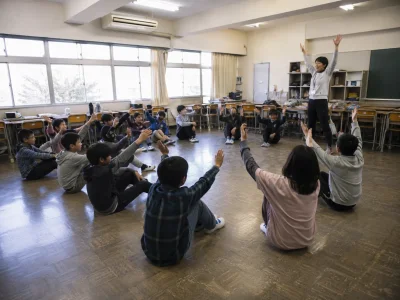
For a trial published in 2011, researchers in six cities across western Washington state enrolled 228 adults with chronic low back pain. They assigned participants to 12 weekly 75-minute yoga classes, 12 weekly stretching classes of the same length, or a self-care book, then waited to see which group improved most. The team at what was then Group Health Research Institute expected yoga to win. It did not. "We expected back pain to ease more with yoga than with stretching, so our findings surprised us," said senior investigator Karen J. Sherman.
That result, repeated in different forms across a decade of trials since, is the most useful thing anyone with an aching lower back can know about yoga. It works, it works about as well as other good exercise, and that makes it a legitimate first treatment rather than a last resort.
The evidence on yoga for chronic low back pain supports it as a reasonable first-line option. The American College of Physicians lists yoga among the nondrug treatments clinicians should start with, a 2022 Cochrane review finds its benefits are modest compared with no exercise, and head-to-head trials show it matching physical therapy and stretching rather than beating them.
What the Guidelines Say
In February 2017, the American College of Physicians published guidance that reordered how doctors in the United States approach back pain. For chronic low back pain, it advised that "clinicians and patients should start nonpharmacologic treatment with exercise, multidisciplinary rehabilitation, acupuncture, mindfulness-based stress reduction (moderate-quality evidence), tai chi, yoga, motor control exercise, progressive relaxation, electromyography biofeedback, low-level laser therapy, operant therapy, cognitive behavioral therapy, or spinal manipulation (low-quality evidence)."
Medication came second. Patients with an inadequate response to nondrug therapy, the college said, "should consider pharmacologic treatment with NSAIDs as first-line therapy, or tramadol or duloxetine as second-line therapy." Yoga sat in the low-quality evidence group within a strong recommendation, which the National Center for Complementary and Integrative Health summarizes plainly as including yoga "as an option for initial treatment of chronic low-back pain (based on low-quality evidence)."
The scale of the problem explains why guidelines care. The World Health Organization reports that low back pain affected 619 million people worldwide in 2020, projects 843 million cases by 2050, and calls it "the single leading cause of disability worldwide."
What the Trials Found
Yoga Against Physical Therapy
The largest head-to-head test came from Robert Saper and colleagues, published in the Annals of Internal Medicine in 2017. The trial enrolled 320 predominantly low-income, racially diverse adults between 18 and 64 with nonspecific chronic low back pain. Participants were randomly assigned to 12 weekly 75-minute yoga classes, up to 15 one-hour physical therapy sessions, or an educational book and newsletters, followed by a 40-week maintenance phase.
The researchers concluded that "a manualized yoga program for nonspecific cLBP was noninferior to PT for function and pain." The same paper reported that yoga "was not superior to education for either outcome," a detail often dropped in retellings. At 12 weeks, people in the yoga and physical therapy groups were less likely than the education group to use any pain medication, and improvements held through the end of the 52 weeks. Adverse events were mostly mild, self-limited joint and back pain, and did not differ between yoga and physical therapy.
Yoga Against Stretching
The 2011 Washington trial reached a similar place by a different route. Participants were encouraged to practice at home for 20 minutes a day, and benefits, including reduced use of pain medication, lasted at least six months for both yoga and stretching. Yoga classes proved "more effective than a self-care book," Sherman said, though no more effective than stretching, and she offered a possible reason: "People may have actually begun to relax more in the stretching classes than they would in a typical exercise class."
Yoga Over a Screen
The most recent addition came from Cleveland Clinic, where Saper now chairs the Department of Wellness and Preventive Medicine. A randomized trial published in JAMA Network Open in November 2024 enrolled 140 adults from the health system's employee health plan, with a mean age of 48 and more than 80 percent women. Half of them received 12 weeks of live-streamed group yoga while the rest waited for their turn. In the trial's abstract, pain fell by 1.5 points more on a 10-point scale at 12 weeks in the yoga group, and by 2.3 points at 24 weeks, with roughly 21 percentage points fewer participants using pain medication.
"Attending yoga classes in person can be challenging," Saper said in the clinic's announcement of the results. First author Hallie Tankha added, "Now we must work to increase access to this safe and effective treatment."
What the Cochrane Review Found
The fullest summary of the evidence is a 2022 Cochrane review led by L. Susan Wieland, which pooled 21 trials with 2,223 participants from the United States, India, the United Kingdom, Croatia, Germany, Sweden and Turkey. Against no exercise, yoga improved back-related function by 1.69 points on the 24-point Roland-Morris scale at three months and reduced pain by 4.53 points on a 100-point scale.
The reviewers called both changes clinically unimportant, since the threshold they used for a meaningful pain change was 15 points. "There is low- to moderate-certainty evidence that yoga compared to no exercise results in small and clinically unimportant improvements in back-related function and pain," the Cochrane review concludes. Against other back-focused exercise, the review found little or no difference.
The Saper and Cleveland Clinic trials both reported effects large enough for participants to cut back on medication. The fair reading is that yoga is one solid form of exercise therapy among several, and none of them is a cure.
Safety and When to Check First
Yoga carries risk like any movement practice. In the Cochrane data, people doing yoga reported more adverse events than people doing no exercise, about 43 per 1,000 against 9 per 1,000, "primarily increased back pain," while the rate was similar to that of other exercise. The National Center for Complementary and Integrative Health notes that yoga is generally considered safe for healthy people "when performed properly, under the guidance of a qualified instructor." The agency adds that people with health conditions, older adults and pregnant women may need to avoid or modify some poses.
Not all back pain is mechanical. The WHO points out that some low back pain "can be explained by an underlying disease (e.g., cancer)" and that pain may be referred from other organs, including the kidneys. Pain that follows an injury, arrives with fever or weight loss, comes with numbness, weakness or changes in bladder or bowel control, or keeps worsening belongs with a clinician before it belongs on a mat.
How to Start a Practice That Matches the Evidence
The trials share a recipe more than a style. Classes ran once a week for 12 weeks, lasted 60 to 75 minutes, were designed for beginners with back pain, and paired with short home practice. Sherman's team stressed that classes should be therapeutically oriented and geared for beginners, which rules out the heated power flow at the gym down the street as a starting point.
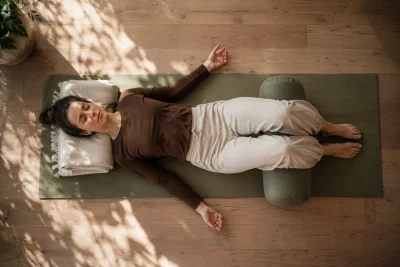
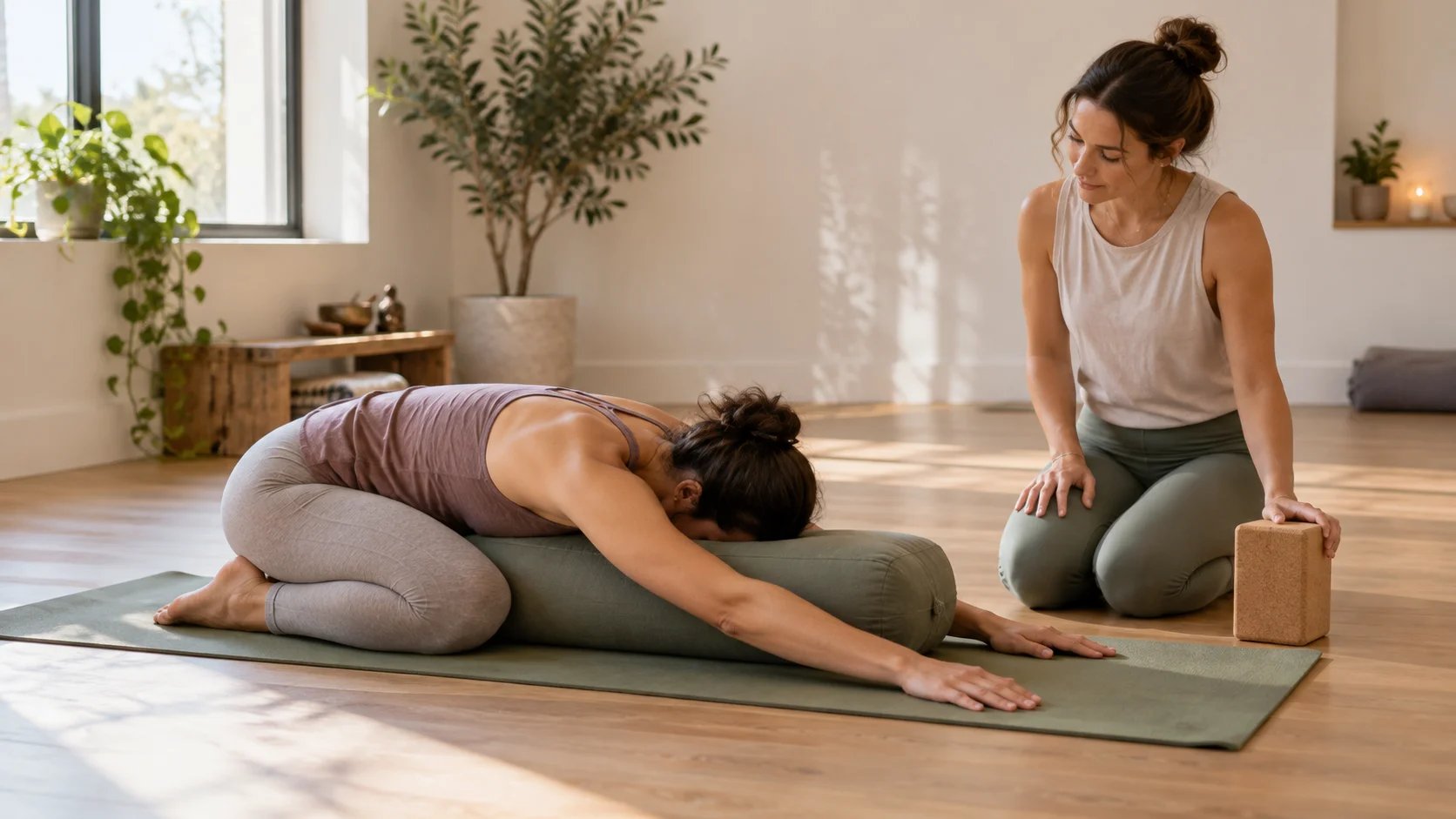
Look for a class described as therapeutic, gentle or back-care yoga, tell the teacher about your pain before the first session, and expect to modify. Blocks, straps and a folded blanket let you approach forward bends and twists without forcing range, and our evidence guide to yoga props covers which tools change what a pose asks of the body. Anyone who has decided their stiffness disqualifies them should start with our guide to yoga for people who think they can't do yoga, because the trials enrolled exactly those people.
Twenty minutes at home on non-class days carries the gains forward, and consistency across the full 12 weeks is where the trial participants saw results. If a pose sharpens pain or sends symptoms down a leg, back out of it and tell your teacher.
Twelve weeks is the length of every major trial above, which makes it a natural point to take stock. If function and pain have not moved by then, the same ACP recommendation lists other exercise, tai chi, mindfulness-based stress reduction and spinal manipulation among the options with evidence behind them.