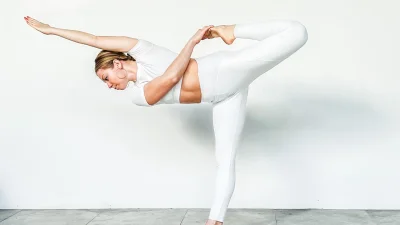
Ask a room of people who lift and also practice yoga when they do each, and the answers arrive in a cheerful jumble. Some run through a long flow before a heavy session because it feels like preparation. Some save it for the evening of a rest day. A few have quietly stopped doing both, because a coach once told them that stretching makes you weak and they never got a second opinion.
There is a defensible answer to the question, and most of it turns on a single number. Sixty seconds is the point at which holding a stretch stops being a warm-up and starts measurably reducing what a muscle can produce in the next hour. Everything useful about scheduling yoga around strength and endurance work follows from that threshold and from a second finding, which is that the long-feared conflict between cardio and lifting turns out to be far smaller than a generation of gym advice assumed.
Helmi Chaabene, David Behm, Yassine Negra and Urs Granacher gathered the acute stretching literature in Frontiers in Physiology in 2019 and found a clean dose response. Static holds of sixty seconds or less per muscle group produced impairments they classified as trivial, on the order of one to two percent. Holds longer than sixty seconds per muscle group produced declines of four to seven and a half percent, which the authors described as substantial and practically relevant.
What the threshold actually rules out
Almost nothing, is the honest answer, and this is where the folk wisdom went wrong. A typical vinyasa sequence moves through postures in a few breaths each and rarely accumulates sixty seconds on any single muscle group before the shape changes. The practices that reliably cross the line are the ones built on long passive holds, which means yin, restorative, and the kind of deliberate hamstring and hip work that a dedicated flexibility session is made of.
So the rule is narrower than it sounds. A three to five minute pigeon hold belongs after training or on its own day. A flowing sequence that keeps things moving belongs wherever it fits, including immediately before a lifting session, where the authors note that short-duration static work integrated into a complete warm-up alongside aerobic activity and dynamic movement showed no performance cost at all.
Their own framing is worth reading closely, because it is more permissive than the usual summary. Short-duration static stretching, they wrote, "should be included as an important warm-up component before the uptake of recreational sports activities due to its potential positive effect on flexibility and musculotendinous injury prevention." The caution they attached applies to competitive athletes, where even a one percent decrement can matter on a given day, and not to someone training four times a week around a job.
The other fear was mostly unfounded
The second worry that shapes how people schedule is the interference effect, the idea that endurance work eats the adaptations from lifting. A 2021 meta-analysis by Schumann and colleagues pooled 43 studies covering 1,090 subjects and found no significant interference for maximal strength or for muscle size. The standardized mean differences were close to zero and the p values were nowhere near significance, which is about as flat a result as this literature produces.
One outcome did move. Explosive strength, the ability to produce force quickly, was reduced by a small but statistically reliable margin. Greg Nuckols, reviewing the analysis at Stronger by Science, summarized the practical upshot without hedging: "the interference effect isn't that big of a deal, and you probably don't need to be that concerned about it most of the time."
Notably, the analysis also found that separating sessions into different parts of the day did not significantly change the outcome for strength. That undercuts a scheduling constraint many people have organized their weeks around, and it frees up the calendar considerably for anyone trying to fit three modalities into six days.
Building the week
Before a heavy session
Keep it moving and keep it short. Cat and cow, a few rounds of sun salutation, controlled lunges with rotation, and shoulder work through range will raise tissue temperature and rehearse the positions the session demands. Hold nothing for a full minute. The goal is to arrive at the first working set warm and organized rather than lengthened, and if a hip feels genuinely restricted, address it with a brief hold and move on rather than parking there.
After a heavy session
This is where the long holds belong, and it is the slot most people underuse. The performance cost of a sixty-second-plus stretch is irrelevant once the working sets are finished, and the down-regulating effect of slow breathing in a supported position does real work at the exact moment the nervous system is looking for a signal that the effort is over. Fifteen minutes is enough. The practice does not need to be strenuous to be useful, and the case for treating recovery as the organizing principle rather than an afterthought is one we made in detail in our piece on building a week around recovery first.
On the day between
A full practice on a non-lifting day is the least constrained option available and the one with the fewest tradeoffs. Length, intensity and style are all free variables. If the week includes a genuinely hard endurance session, put the longer yoga practice on a different day from it, not because of interference but because two long sessions on one day tends to be the thing that gets skipped by Thursday.
In the morning, on any day
Short morning practice is a habit mechanism more than a training input, and it should be judged that way. Ten to fifteen minutes of movement before the day begins reliably survives contact with a real schedule, which is more than can be said for the hour-long class that requires a commute, and the structure of a compact morning flow is designed around exactly that constraint.
What to change if you are training for something
An athlete with a competition date has one adjustment to make, and it is a small one. In the final week before a meet, a race or a match, move all long-hold work away from the two days preceding the event and keep pre-competition preparation to dynamic movement only. The one to two percent decrement that a recreational lifter can safely ignore is the margin that decides a personal best, and the Frontiers authors were explicit that high-performance contexts warrant the extra caution.
Anyone chasing explosive qualities, whether that means jumping, sprinting or Olympic lifting, should also give the endurance side of their week a hard look, since that was the one outcome the meta-analysis found genuinely affected. The fix is not to remove conditioning but to keep the heaviest endurance blocks away from the days built around speed.
The version most people should follow
Practice something short and moving before you lift, practice something long and still after you lift or on the days you do not, and stop trying to defend a fifteen-minute schedule change with physiology that was measured on trained athletes performing maximal efforts. The evidence supports far more flexibility in yoga programming than the received wisdom does, and the sessions that actually happen consistently over a year outperform the perfectly sequenced week that lasts three of them.
Sixty seconds is the only number worth memorizing. Below it, put the practice wherever it fits. Above it, put it after the work.