In most yoga rooms there is one student whose forward fold puts her forehead flat against her shins on the first attempt, and the rest of the room quietly uses her as the benchmark. She is often the person in that room most likely to end up in a physiotherapy clinic. Her joints travel further than the rules of a textbook range of motion allow, and the practice she has been praised for is the one training her to keep going there.
The correction is not to stop practicing. It is to stop treating depth as the measure. A body with generalized joint hypermobility needs a practice organized around control, strength through the middle of a range, and the ability to feel where a limb is without looking at it. That practice is slower and considerably less photogenic than the one being demonstrated at the front of the room.
What the Beighton Score Measures
The screening tool used across the research literature is the Beighton score, a nine-point assessment that checks whether the little fingers extend past ninety degrees, whether the thumbs fold to the forearms, whether the elbows and knees hyperextend, and whether the palms reach the floor with the knees straight. Studies commonly treat a score of four or above as the threshold for generalized joint hypermobility.
What the score does not do is diagnose anything. It flags a pattern of joint laxity, which for many people is unremarkable and produces no symptoms across a lifetime. For others it sits alongside pain, fatigue, or repeated joint instability, and that combination belongs with a clinician rather than with a yoga teacher. Anyone who scores highly and hurts should get assessed properly.
The exercise guidance published by the Ehlers-Danlos Society, written by Jason Parry, an extended scope physiotherapist at University College London Hospital, and peer reviewed by Dr Jane Simmonds of the Great Ormond Street Institute of Child Health, states the practical rule in a single line that belongs on every studio wall.
Just because it goes there doesn't mean you should take it there.
The Gap Between Range and Control
Range and control are separate capacities, and the second one is what keeps a joint intact. Parry's guidance describes proprioception as the body's ability to sense position and movement, and puts the relationship plainly: the better your proprioception, the better your stability.
A study published in BMC Musculoskeletal Disorders in January 2023 puts numbers on that gap. Zong-chen Hou and colleagues at Peking University recruited forty patients with chronic ankle instability and split them by Beighton score, twenty with generalized joint hypermobility at four or above and twenty below it, then ran both groups through the same three-month supervised balance training programme.
At baseline the two groups looked similar on most measures, with one exception. On the star excursion balance test, the hypermobile group reached notably shorter in the posteromedial direction, 83.6 percent against 92.8 percent, and in the posterolateral direction, 84.7 percent against 95.7 percent. The joints that moved more freely were the ones with less usable balance control at the end of the movement.
That study looked at ankle patients rather than yoga students, and its findings should not be stretched into a claim about every hypermobile body in a studio. What it does establish is that laxity and control are measurably different things, which is precisely the distinction a depth-based practice erases.
Where the Practice Goes Wrong
Three cues do most of the damage, and none of them is malicious. "Straighten the leg" produces a locked, hyperextended knee in a body that has fifteen degrees of extension available. "Reach a little further" in a seated forward fold pulls at hamstring attachments that are already at the end of their travel. "Melt into the pose" in a long passive hold parks a lax joint at its outer limit for three minutes with no muscular support underneath it.
The seductive part is that all three feel productive. Passive end range produces a strong sensation, and sensation is what most practitioners use as their evidence of work being done. A hypermobile student chasing sensation has to travel much further than a stiff one to find it, and the place she finds it is past the point where muscle is doing the holding.
Long passive holds deserve specific mention because they are marketed as the gentle option. A restorative or yin-style hold is gentle for a body whose connective tissue provides its own end stop. For a body without that end stop, several minutes of unsupported loading at the outer range is not rest.
What Changes When You Train Stability Instead
The encouraging half of the Hou study is what happened after training. Following three months of balance work, the hypermobile group recorded a lower re-sprain rate than the non-hypermobile group, 11.1 percent against 23.5 percent immediately after training and 16.7 percent against 29.4 percent three months later. They also showed greater gains in self-reported function and in both plantarflexion and dorsiflexion strength.
The authors concluded that patients with generalized joint hypermobility gained equally or better postural stability and muscle strength from balance training than those without it. Lax joints are not a fixed ceiling. They respond to loading, and they respond well.
The Cues That Replace "Go Deeper"
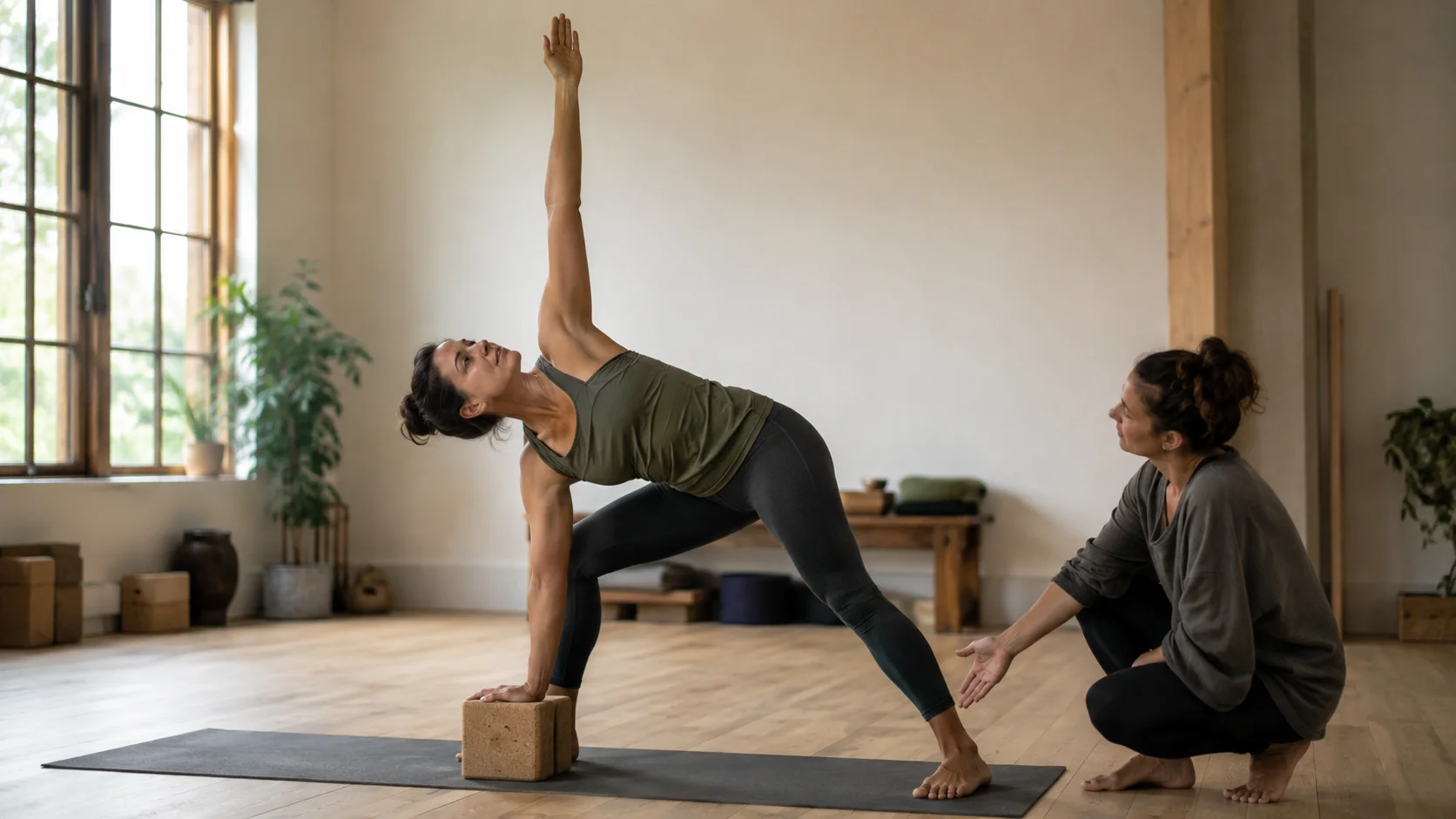
Work at roughly ninety percent of available range and stop there. In a forward fold, that means bending the knees enough to feel the hamstrings working rather than pulling. In triangle, it means resting a hand on a block at shin height instead of the floor, so the side body holds itself rather than hanging.
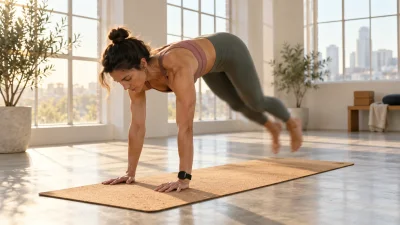
Add a micro-bend to every straight limb. A soft knee in warrior three and a soft elbow in plank keep the load in muscle instead of parking it on the joint capsule. In weight-bearing poses on the hands, spread the load across the whole palm and grip the mat lightly with the fingertips, which recruits the forearm rather than collapsing into the wrist.
Favour standing balance work, single-leg holds, and slow transitions over long floor holds. These are exactly the tasks that train the joint position sense the Ehlers-Danlos guidance identifies as the foundation of stability, and they are the same skill set that interoception training builds for athletes.
Pacing
The guidance is specific about starting volume: begin with low-intensity exercise for five to ten minutes, two to three times per week, and build from there. A hypermobile body that has been overstretching for years often has strength deficits under the mobility, and the correction produces soreness faster than expected.
Parry's guidance notes that yoga can work well with a good teacher, and the qualifier is doing real work in that sentence. A teacher worth practising with will offer a block before you ask, will not adjust you deeper into a pose, and will not treat the deepest version in the room as the correct one.
A Different Definition of Progress
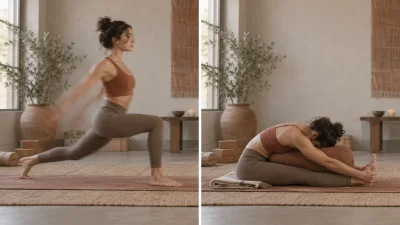
The measure worth tracking is not how far you get but how long you can hold a position without shaking and without locking out. Thirty seconds in a half-kneeling lunge with a level pelvis and an unlocked back knee is a harder achievement, for a hypermobile body, than any forward fold.
This is the same reframing we made the case for when arguing that beginner progress has never been about flexibility. For a hypermobile practitioner the stakes are simply higher, because the flexibility she is being congratulated on was never the thing she needed to build.
Ask the teacher for a block. Bend the knee. Stop at ninety percent.