Most morning routine advice is written by people who are already morning people. They get out of bed at 5 a.m., greet the sunrise with enthusiasm, and treat the early hours like a gift rather than an inconvenience. If that is you, wonderful. But if you are the kind of person who hits snooze twice, negotiates with yourself for ten more minutes, and shuffles to the coffee maker in something resembling a walking coma, this one is for you.
Because here is what the relentlessly cheerful morning-routine industry rarely admits: you do not need to love mornings for a morning yoga practice to change them. You just need fifteen minutes and a floor.
The 15-minute morning flow described in this guide is specifically designed for people who are not naturally wired for early energy, who do not want to think too hard before 8 a.m., and who need a routine that feels like easing in rather than launching out. It works precisely because it does not ask for what most people do not have first thing in the morning -- which is effort.
There is a physiological argument for morning yoga that has nothing to do with motivation, willpower, or discipline. When you wake up, your body has been in a relatively static position for six to eight hours. Your connective tissue is slightly more hydrated, your nervous system has had a reset, and your cortisol levels, the hormone responsible for alertness and stress response, are naturally peaking. That last part sounds counterintuitive, but it is actually an asset.
Morning cortisol gives you a natural, built-in window of mental clarity before the demands of the day layer on top of it. A short morning yoga routine done in that window does not fight your biology -- it works with it. The gentle movement signals the body that it is time to shift from sleep mode to waking mode without the abrupt jolt of an alarm or the slow drift of lying in bed scrolling.
Research published in the Journal of Alternative and Complementary Medicine found that participants who practiced yoga in the morning reported significantly better mood and reduced anxiety throughout the day compared to those who practiced at other times. The morning window, it turns out, is when the downstream effects of yoga are most far-reaching.
And for non-morning people specifically, a gentle yoga flow offers something that coffee, cold showers, and alarm-clock tricks cannot: a gradual, body-led transition into wakefulness that actually feels good rather than forced.
This sequence is designed to be done in the order listed, on a mat or any non-slip surface, without any props required. It moves from the floor to standing slowly and intentionally, which matters more than most people realize. Standing up too quickly after sleep is a fast way to feel dizzy and unmotivated. This flow respects the body's natural morning pace.
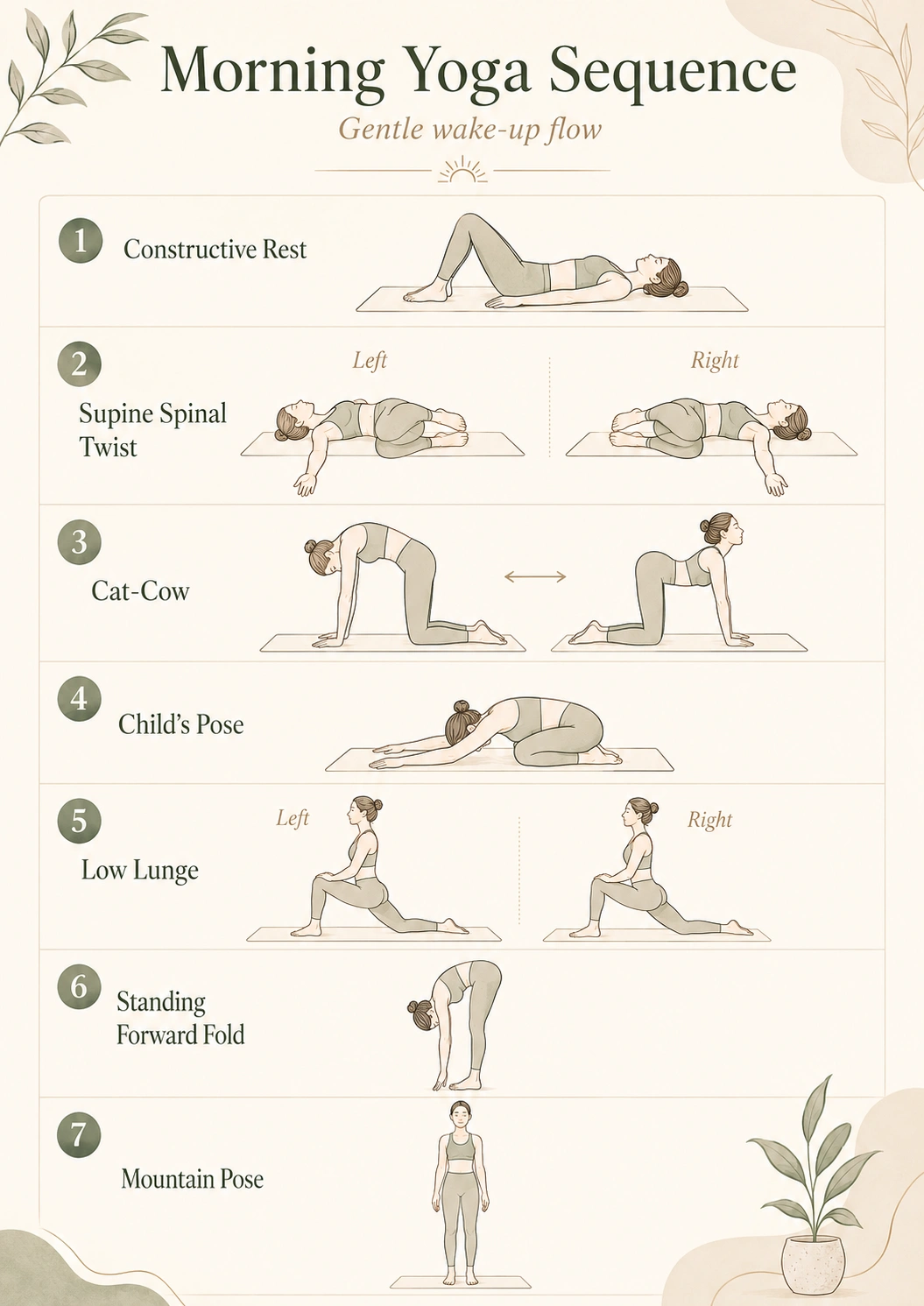
Start with two minutes lying flat on your back in Constructive Rest. Knees bent, feet flat on the floor, arms relaxed at your sides. Eyes closed. This is not sleeping. This is arriving. Take five slow breaths and notice where your body feels heavy, tight, or still asleep. No fixing required, just noticing. This small act of body awareness before movement is a foundational mindfulness practice that sets the entire tone of the session.
The 2026 Sustainable Mat Guide: Beyond the "Eco-Friendly" Buzzword
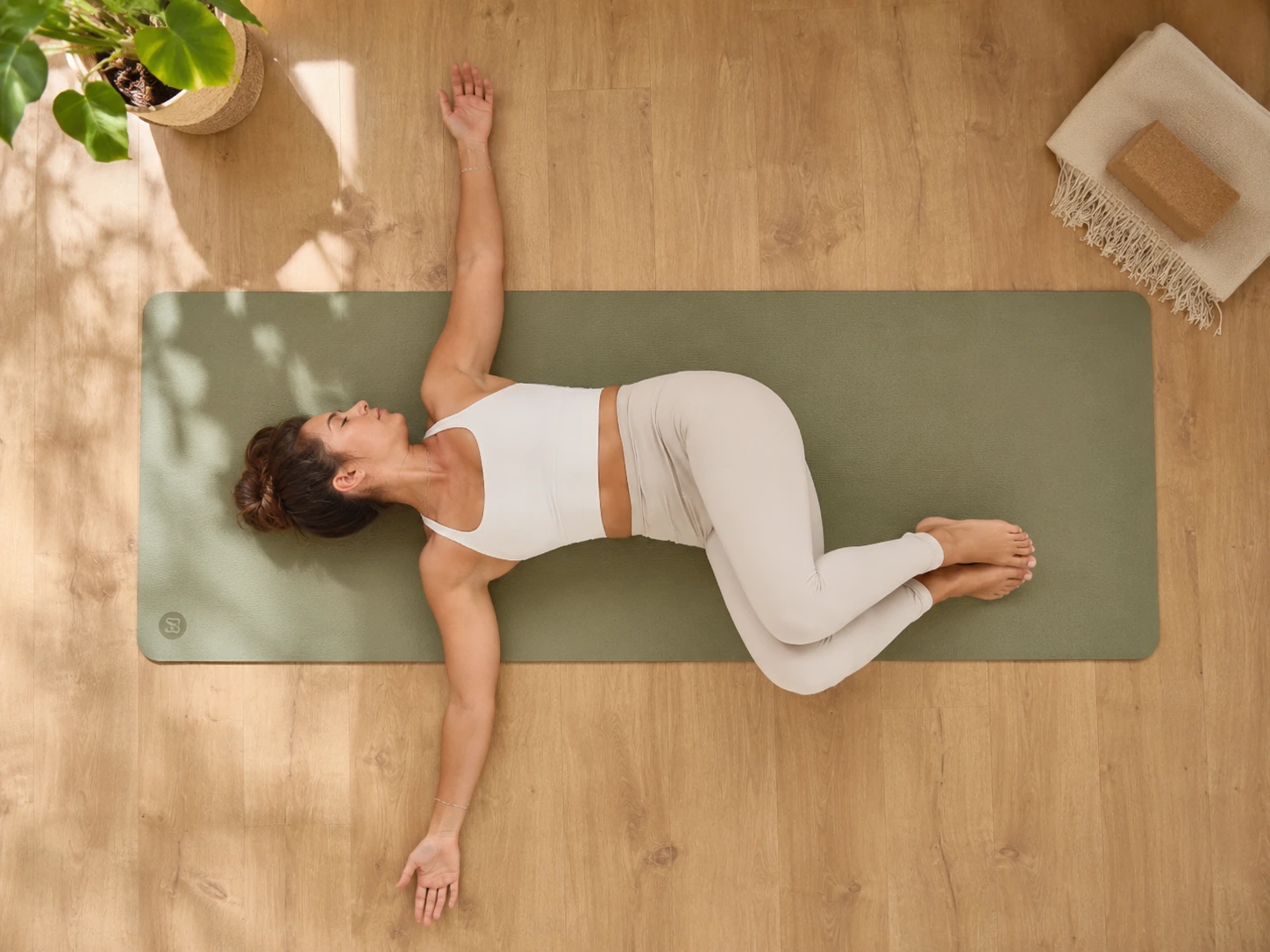
From there, move into Supine Spinal Twist, holding each side for sixty to ninety seconds. Draw one knee into your chest, let it fall across your body, extend the opposite arm, and breathe into the side of your ribcage. The spine has been compressed during sleep, and this gentle rotation begins to restore its natural mobility. Most people feel an almost immediate sense of relief in the lower back within the first breath.
Next, come to hands and knees for two minutes of Cat-Cow. This is arguably the single most underrated pose in yoga for morning use. The rhythmic flexion and extension of the spine wakes up the vertebrae, stimulates circulation along the back, and coordinates breath with movement in a way that gently activates the nervous system without demanding anything strenuous. Move slowly. Let the breath lead the movement rather than the other way around.
From Cat-Cow, press back into a Child's Pose for ninety seconds. Arms extended or alongside the body, forehead resting on the mat, hips settling toward the heels. This is your first true rest point and also one of the most effective stress-reducing postures in a beginner yoga routine. The gentle compression of the torso and the folded position of the hips stimulate the vagus nerve, which plays a direct role in activating the parasympathetic nervous system. In plain language: it tells your body it is safe to be calm.
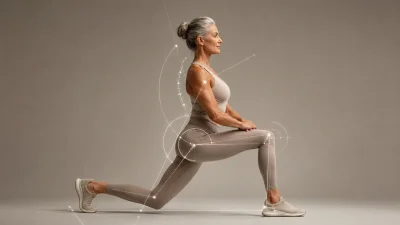
Come to standing slowly through a Low Lunge on each side, holding for sixty seconds per leg. Place the back knee down if needed. Let the hips sink rather than forcing them. Hip flexors are notoriously tight after sleep, especially for people who sit at a desk during the day, and opening them in the morning creates a measurable difference in how the lower body feels for the rest of the day. This is one of the best yoga poses for beginners because the benefit is immediate and obvious.
Move into a brief Standing Forward Fold, knees soft, for forty-five seconds. Let the head hang completely. This is not about reaching the floor. It is about decompressing the spine in the other direction, releasing the hamstrings gently, and getting blood flowing toward the head and face. Many people find this is the moment the morning fog actually lifts.
Close the sequence in Mountain Pose for one final minute. Stand with feet hip-width apart, hands at your sides, eyes soft or closed. Take three deep breaths with a longer exhale than inhale. This closing stillness is not optional or decorative. It is where the body integrates everything it has just done, and it is where the mindfulness practice of the morning becomes complete rather than just a series of physical movements.
The poses above are the structure. The mindfulness component is what turns them from a stretching routine into something that genuinely shifts how you move through the day.
The key is breath awareness at every transition. Before you move from one pose to the next, take one conscious breath. Not a performance breath, just a real one. Notice whether it is shallow or full, whether your exhale is rushed or easy. This single habit, applied consistently, begins to train the nervous system to use the breath as an anchor rather than just a background function.
Set a simple intention at the start of the sequence, before your first breath in Constructive Rest. It does not need to be philosophical. It can be as direct as "I want to feel less reactive today" or "I want to stay focused during my morning meeting." Research on intentional priming, the practice of consciously setting a mental direction before beginning a task, shows measurable effects on attention and emotional regulation throughout the day. Yoga provides an unusually clean window for this practice because the body is already slowing down and the mind has not yet filled with the noise of the day.
Finally, resist the urge to check your phone before the sequence is complete. Morning screen exposure triggers an immediate cortisol and dopamine response that makes the grounded, easeful quality of a yoga morning nearly impossible to achieve. Even five minutes of scrolling before your practice fundamentally changes the nervous system state you bring to the mat. The sequence works best when it is the first thing you do after waking, before input rather than after it.
In the first few days, the practice will feel awkward. You will forget poses, lose track of the sequence, and probably spend at least one session wondering if you are doing it right. That is completely normal and genuinely does not matter. The body does not need precision in the early days. It needs consistency and permission to move without judgment.
By the end of the first week, most people notice two things: they are waking up slightly easier, and their mornings feel less reactive. Not dramatically transformed, just quieter. A little more spacious. The transition from bed to the rest of the day feels less like a collision and more like a handoff.
By the second week, the sequence starts to feel like it belongs to you. The poses become familiar enough that your body begins to anticipate them, and the mindfulness layer deepens naturally because you are no longer spending energy remembering what comes next. This is where morning yoga benefits really begin to compound, both physically and mentally.
A 2021 study in Frontiers in Psychiatry found that just twelve days of morning yoga practice produced significant improvements in perceived stress, sleep quality, and overall wellbeing in participants with no prior yoga experience. Twelve days is two weeks. That is a remarkably short runway for a habit with that kind of return.
You do not have to enjoy waking up early for this to work. You do not have to feel motivated or inspired or grateful for the morning. You just have to get to the floor. The practice will do the rest. Yoga for beginners in the morning works not because it demands energy you do not have, but because it generates energy from the simplest possible inputs: breath, movement, and a few minutes of quiet before the world gets loud.
The mat is not asking you to be a morning person. It is just asking you to show up as the person you are right now, groggy and unpolished and five minutes out of bed, and let fifteen minutes do what fifteen minutes, done consistently, actually can.
That turns out to be quite a lot.