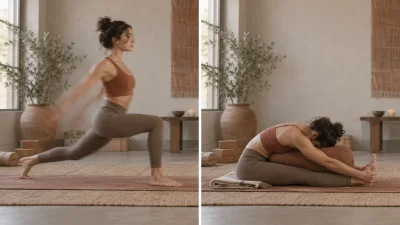
Somewhere in the last year or two, the language in yoga studios changed. The cues used to be about alignment and breath: square your hips, lengthen your spine, inhale to reach. Now you are just as likely to hear a teacher talk about "downregulating," "settling the body," or "coming back into your window of tolerance." If you have left a class wondering when yoga started sounding like a neuroscience lecture, you are not imagining it. A real shift is underway, and it is one of the most meaningful changes to hit the practice in a decade.
Here is the short version, the part you can take with you even if you read nothing else. The newest wave of yoga is less interested in how a pose looks and more interested in how it makes your body feel safe. The goal is to teach your stress physiology to shift gears on command, out of high alert and into rest. That is the whole project behind somatic yoga, and it explains why your teacher keeps reaching for the word "nervous system."
For most of modern wellness, the dominant message has been top-down: change your thoughts and your body will follow. Talk yourself out of the spiral. Reframe the worry. That works, sometimes, but anyone who has tried to think their way out of a racing heart at 3 a.m. knows its limits. The body does not always take instructions from the mind.
The somatic approach flips the direction. It is a "bottom-up" practice, meaning it starts with the body and lets calm travel upward to the brain. Slow movement, deliberate breathing, and gentle attention to physical sensation send signals through the body that the brain reads as safety. This is the mechanism behind nervous system regulation, the skill of guiding your physiology between states of alertness and rest rather than being stuck in one gear. You are not convincing yourself you are calm. You are giving your body the raw evidence of it.
The science here is not fringe. Research on breath and movement practices has consistently shown that bottom-up techniques influence cardiovascular, musculoskeletal, and nervous system function, with downstream effects on stress hormones and emotional wellbeing. In other words, what you do with your body measurably changes what happens in your chemistry.
If there is one anatomical celebrity behind this movement, it is the vagus nerve, a long, wandering nerve that runs from the brainstem down through the throat, heart, lungs, and gut. It is the main highway of your parasympathetic nervous system, the branch responsible for rest, digestion, and recovery. Stimulating it, gently and naturally, is the closest thing yoga has to a calm switch.
What makes the vagus nerve so interesting is the direction its traffic flows. Roughly eighty percent of its fibers carry information upward, from the body to the brain, not the other way around. Your internal organs are constantly reporting their status to your mind, and that stream of information shapes how safe or threatened you feel. This is why a long, slow exhale can take the edge off panic faster than any pep talk. Deep, unhurried breathing has been shown to stimulate the vagus nerve and shift the body toward its parasympathetic, recovery-oriented state.
Much of the vocabulary you are hearing traces back to polyvagal theory, a framework developed by neuroscientist Stephen Porges that describes how the autonomic nervous system moves through a hierarchy of states: social and safe, mobilized for fight or flight, or shut down and collapsed. A 2018 paper in Frontiers in Human Neuroscience made the case directly, arguing that yoga therapy and polyvagal theory converge beautifully, ancient practice and modern neuroscience pointing at the same target: self-regulation and resilience. Teachers absorbed that language, and now it is everywhere.
The other word worth knowing is interoception, your ability to sense the internal state of your body: the flutter of your heartbeat, the tightness in your chest, the settling in your belly. It sounds abstract, but it is the foundation of the whole practice. You cannot regulate a nervous system you cannot feel. Somatic work trains this sense deliberately, asking you to notice sensation without rushing to fix or judge it, which is why these classes often feel slower and quieter than the vinyasa flows many of us came up on.
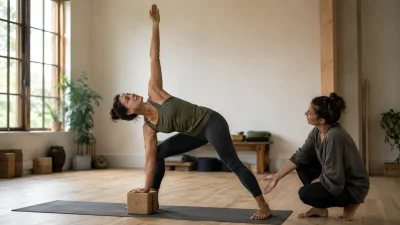
This is also where trauma-informed yoga enters the picture, and where the stakes get real. For people carrying the residue of difficult experiences, a fast, performance-driven class can backfire, flooding a system that is already on edge. Trauma-informed and trauma-sensitive approaches strip out the pressure: fewer commands, more invitations, an emphasis on choice and on noticing what feels tolerable. The research, while still early, is encouraging. Studies of trauma-informed programs have reported improvements in self-compassion, reduced burnout, and better mental health among groups ranging from educators to college students living with high stress.
That last point explains the timing. A generation worn down by chronic stress, grief, and overwork has gone looking for something that addresses the body and not just the calendar. Talk therapy has long waiting lists and a top-down ceiling. Medication helps many and is not for everyone. Movement that calms the body from the inside is accessible, repeatable, and free once you know how. The cultural moment and the science arrived at the same door at the same time.
You do not need a workshop or a new mat to taste this.
The simplest entry point is the breath, and it is the heart of somatic breathwork: make your exhale longer than your inhale. Breathe in for a count of four, out for a count of six or eight, and repeat for two or three minutes. The extended exhale is what nudges the vagus nerve and tips you toward rest. Pair it with a slow, unhurried movement, a gentle spinal twist, a forward fold you sink into rather than force, and pay attention to the sensations rather than the shape. Notice where your body softens. That noticing is the practice.
It helps to support the body outside the mat too. Hydration and recovery shape how resilient your stress physiology is day to day, which is why nervous system work pairs naturally with the broader habits covered over at H2Goals, and readers drawn to gentler, body-first approaches to stress often find a kindred philosophy in the natural wellness coverage at SupportNAC. None of this requires buying anything. The point of the somatic shift is that the most powerful tool you own is the one you were born with.
So the next time your teacher mentions your nervous system, you will know it is not jargon for its own sake. It is a quiet acknowledgment that yoga was always doing this, calming the body, settling the mind, restoring some baseline of safety, long before anyone had the brain scans to prove it. The language is new. The relief is ancient.
This article is for general educational purposes and is not a substitute for professional mental health or medical care. If you live with trauma or a diagnosed condition, consider working with a qualified trauma-informed teacher or clinician.