The clocks fall back tomorrow, Sunday, and for many people that hour of lost evening light marks the point where the studio commute starts to feel long. The 6 p.m. class across town competes with dark streets, cold rain and a couch that looks better every week, and attendance across the winter tends to thin out accordingly.
The research on home practice suggests that the mat in the corner of the living room may matter more than the class on the calendar. Investigators surveyed 1,045 students drawn from 15 Iyengar studios across the United States. How often those students practiced at home predicted a cluster of health measures more reliably than how long they had practiced or how often they went to class.
Building a home yoga space that makes daily practice easy is mostly a matter of a few practical decisions about floor, mat, heat and light, made once and then left alone. The other half of the story is knowing what a home setup cannot replace.
What the Home Practice Research Shows
The 2012 survey by Ross and colleagues, published in Evidence-Based Complementary and Alternative Medicine, found that frequency of home practice favorably predicted mindfulness, subjective well-being, body mass index, fruit and vegetable consumption, vegetarian status, sleep and fatigue. Its conclusion was blunt: "Home practice of yoga predicted health better than years of practice or class frequency." Respondents practiced outside class on a mean of 12.2 days a month.
The study has limits worth naming. It was cross-sectional, it relied on self-report, and its respondents all came from a single tradition known for exacting alignment instruction, so it shows that home practitioners were healthier, not that the home practice made them so.
A German national survey published in BMC Complementary and Alternative Medicine in 2019 by Holger Cramer's group shows how much of yoga already happens off the studio floor. Its 1,702 respondents practiced in class for 84.9 minutes a week on average but for 166.3 minutes at home. The same survey carried the caution that shapes everything below: practicing only by self-study, without any supervision, was associated with a higher risk of adverse effects.
The National Center for Complementary and Integrative Health makes the same point in its guidance on yoga safety, noting that serious injuries are rare and that "learning yoga on your own without supervision has been associated with increased risks." The sensible reading of both bodies of evidence is a home practice built on instruction, with a teacher who has seen you move, whether in a room or on a live video call.
Finding the Floor
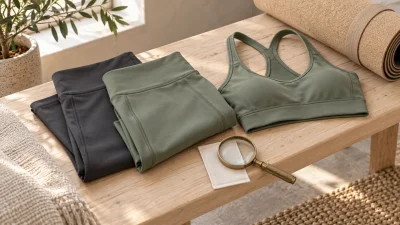
Space is the first constraint, and the mats themselves set the minimum. Manduka lists its PRO at 71 by 26 inches in the standard length, Jade makes its Harmony 24 inches wide in 68 and 74 inch lengths, and Lululemon sizes The Mat 5mm at 26 by 71 inches. A clear rectangle a little longer and wider than the mat, with room to sweep the arms overhead and out to the sides without striking a bookshelf, covers almost every standing and floor sequence.
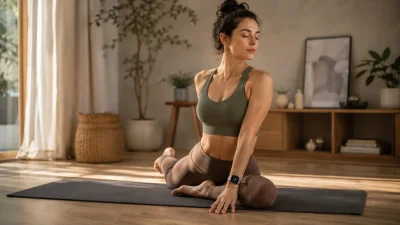
Firm floors work best. Hardwood, laminate, tile and low-pile rugs give a stable base for balance poses, while thick carpet lets the mat shift and the wrists sink during weight-bearing work. If the only open floor is carpeted, a thin plywood board or a firm interlocking tile under the mat restores some stability.
Cleveland Clinic's guide to home practice recommends a space free of clutter so there is enough room to move safely. The practical version is a short checklist before each session: pets out, cords tucked, nothing sharp within a fall's reach of the mat.
Thickness, Grip and What the Mat Is Made Of
Mat thickness is a trade between cushion and stability. Manduka describes its 6mm cushion as protection for knees, wrists and other sensitive points during weight-bearing postures, while Jade's Harmony runs 3/16 of an inch, about 4.8mm, in natural rubber. Thicker mats suit hard floors and practices heavy on kneeling and floor work, while thinner mats give better feedback in standing balances.
Material affects grip and also who can use the mat. Manduka builds the PRO from PVC, while Lululemon's natural rubber mat carries an explicit warning that people with rubber or latex allergies should avoid contact with it, a detail worth checking before a household shares one mat. For practitioners whose palms sweat, a rubber surface or a towel layer usually holds better than smooth PVC.
A small kit of props rounds out the space. Our earlier guide to blocks, bolsters and straps covers what the evidence says each one does, and a pair of blocks and a strap fit easily into a basket at the end of the mat.
Heat and Light
Winter brings the temperature question home. The World Health Organization's housing and health guidelines propose 18 degrees Celsius, about 64 degrees Fahrenheit, as a safe indoor minimum in colder climates during cold seasons. They add that a higher minimum may be needed for older people, children and those with chronic illness. That is a health floor for living spaces rather than an ideal for practice, and most people will want the room a few degrees warmer for slow, floor-based sessions.
Turning the thermostat well past comfort is a separate decision with its own trade-offs, which we examined in our comparison of hot and room-temperature yoga. For a home practice, layers that come off as the body warms do the job without a space heater.
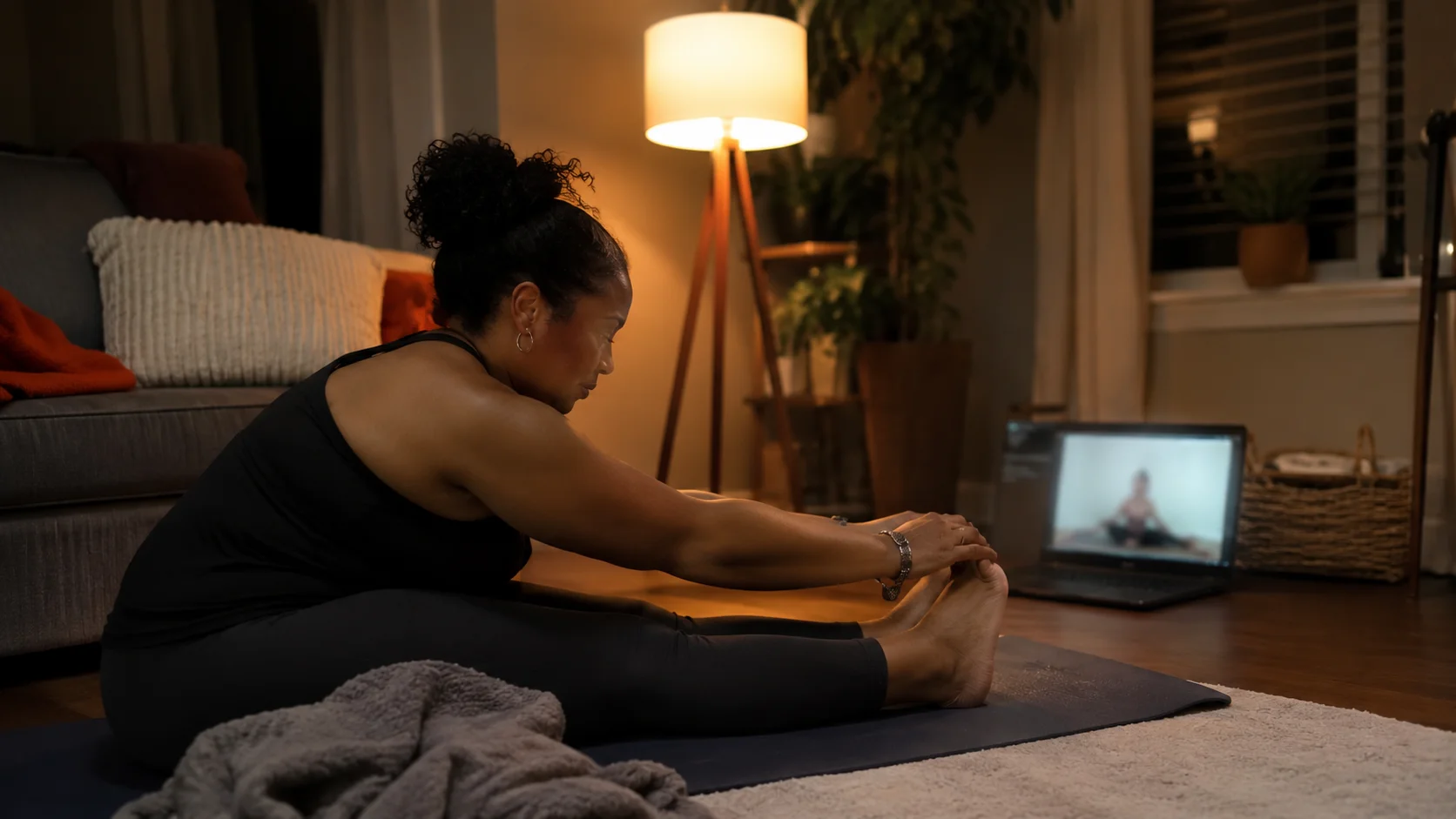
Light deserves as much thought as heat. A 2022 consensus statement in PLOS Biology recommended a minimum daytime melanopic equivalent daylight illuminance of 250 lux at the eye and a maximum of 10 lux during the three hours before bedtime. A morning session near a bright window, or under bright overhead light, fits the first number, while an evening wind-down practice belongs under a single low lamp.
The Mirror Question
Many home spaces borrow the studio habit of a full-length mirror, and the research on that choice is thin but suggestive. In a 2015 doctoral dissertation at the University of Minnesota, 97 college-aged women were randomized into a 60-minute beginner class in either a mirrored or non-mirrored room. The non-mirrored group reported significantly lower social physique anxiety after the class, while the mirrored group reported more appearance-based social comparison.
A mirror can help check alignment in a specific pose, and turning it away or covering it for the rest of the session is an easy compromise. The goal of a home practice is attention inward, and a reflection pulls the eyes outward.
Screens, Teachers and Knowing Your Limits
For anyone following an online class, the screen belongs at the short end of the mat. Set it far enough away to show the teacher's whole body and high enough to see without craning the neck in downward dog. Live classes with a camera on let a teacher correct what a recorded video never sees.
Emergency department data put home injuries in proportion. University of Alabama at Birmingham researchers Thomas Swain and Gerald McGwin estimated 29,590 yoga-related injuries treated in U.S. emergency departments from 2001 to 2014, with the trunk the most frequently injured region and sprains and strains accounting for 45 percent of diagnoses. About 15 percent of those injuries were recorded at home, though the location was missing for nearly a third, so the figures cannot show whether home practice is riskier or safer than class.
"Yoga is harder and more demanding than some people believe," McGwin said in the university's release. "A qualified, certified yoga instructor can help you with that assessment and is essential to a safe experience."
Johanna Goldfarb, a Cleveland Clinic physician and registered yoga teacher, offers a simple line for the home mat: "A gentle stretch is OK, but pain in a joint is a red flag." Her other advice applies before the first session in the new space: "Take enough classes to learn the proper alignment in each position and avoid injury."
With a firm floor, a mat that suits the practice, a warm room and a teacher checking in now and then, the space does what the Ross survey suggests matters most. It makes the twelfth session of the month as easy to start as the first.